Governing the Wrong Layer: How AI Governance Frameworks Are Locking In LMIC Exclusion
Why compute infrastructure concentration not model deployment rules is the governance failure that will determine global AI equity for the next fifty years
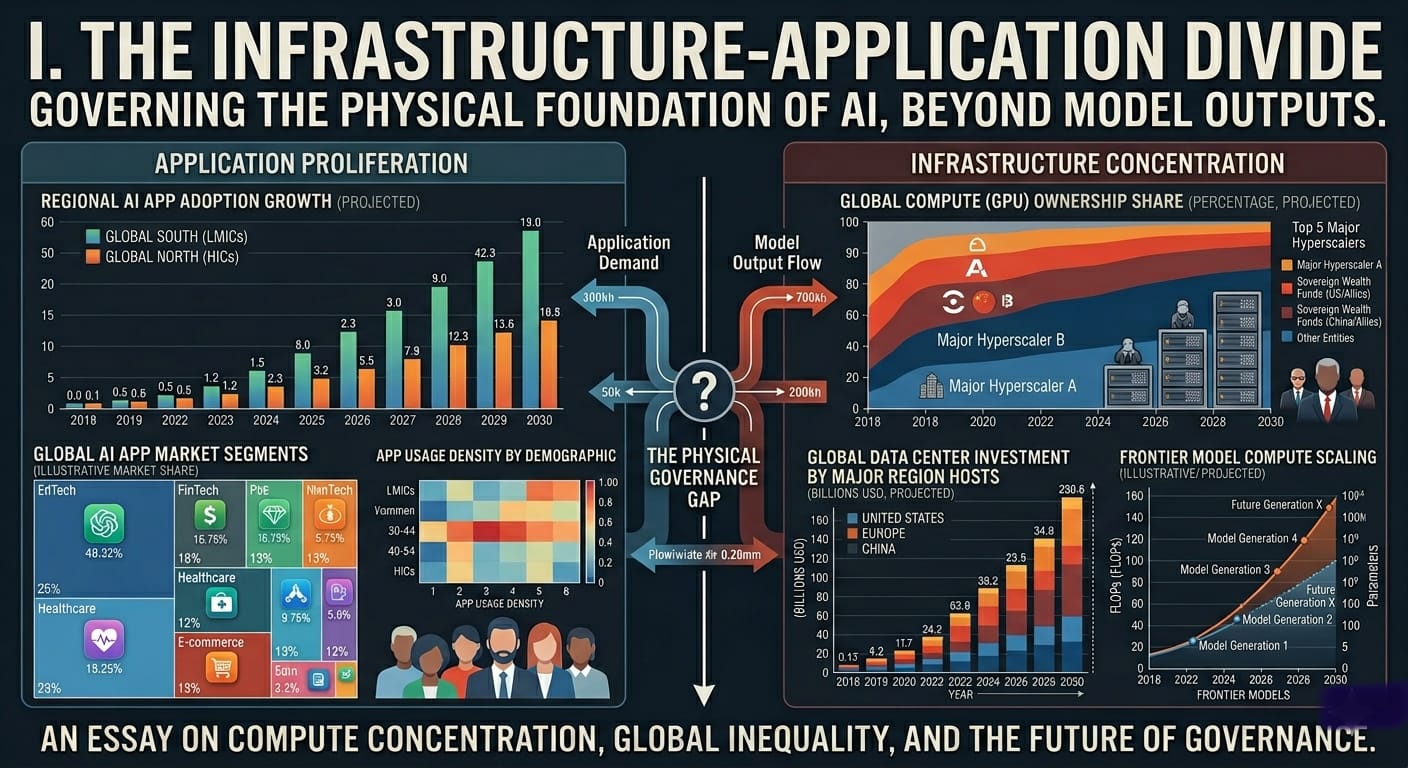
I. The Infrastructure-Application Divide
The observation that technology availability does not automatically overcome deployment barriers is not new. Electricity has existed as a usable technology for over 140 years. Significant portions of the global population still lack reliable access to it not because the technology is unavailable, but because the infrastructure required to deliver it was never built at scale in their regions. The technology existed. The deployment infrastructure did not.
AI is following the same pattern, but with one critical difference: the infrastructure layer is not merely underfunded it is actively concentrating into a small number of private hands with no governance framework constraining that concentration.
Every technology separates into two distinct layers. The application layer software products, interfaces, AI-powered services generates high returns on investment quickly. Private capital flows here efficiently. The infrastructure layer data centers, semiconductor fabrication, power grids, fiber optic cables generates lower returns, requires long time horizons, and functions as a public good whose benefits are broadly distributed but whose costs are concentrated on whoever builds it. Private markets systematically underinvest in infrastructure for exactly this reason.
In AI, the infrastructure layer is compute: specifically, the advanced semiconductor chips required to train frontier models and the data centers required to run them. This infrastructure is not being built broadly. It is being built by a handful of hyperscalers primarily in the United States, with secondary capacity in Europe and China. The rest of the world Latin America, Sub-Saharan Africa, South and Southeast Asia is application territory, not infrastructure territory.
II. The Governance Blind Spot
The EU AI Act is the most comprehensive AI governance framework currently in force. It establishes risk tiers, conformity assessment requirements, and obligations for general purpose AI models with systemic risk. It does not establish any mechanism for governing the geographic concentration of compute infrastructure. The GPAI provisions are entirely focused on what models can do and how developers must evaluate them not on where the physical capacity to train those models is located or who owns it.
The Hiroshima Process G7 AI Principles, adopted in October 2023, identify transparency, accountability, and safety as core values. They say nothing about compute infrastructure access or the structural conditions under which AI capability will be distributed globally.
National AI strategies in the US, UK, and EU are similarly configured. They address domestic competitiveness, export controls to adversaries, and safety requirements for domestic deployment. International infrastructure equity does not appear in their frameworks as a policy problem.
This is not an oversight it reflects whose interests shaped these frameworks. The countries writing AI governance rules are the same countries hosting the compute infrastructure. The countries excluded from compute infrastructure are not at the table where governance rules are written.
The result is a governance architecture that effectively codifies the current distribution of AI power as the baseline against which all future policy is measured. The infrastructure concentration that exists today is treated as a given, not as a problem to be addressed.
III. The LMIC Consequence: Lock-In at the Governance Stage
The exclusion of LMICs from AI compute infrastructure is typically framed as a market outcome a natural consequence of capital flowing toward high-return environments. This framing is incorrect and consequential.
LMIC exclusion is being locked in at the governance stage, not the market stage. The mechanism works as follows.
Compute infrastructure requires massive capital investment and long time horizons to become commercially viable. The entities capable of making these investments at scale are hyperscalers and sovereign wealth funds in advanced economies. As these entities build infrastructure, they establish legal ownership structures, commercial agreements, and regulatory relationships with host governments. These structures, once established, are extremely difficult to displace.
By the time LMICs develop sufficient economic weight and political leverage to demand meaningful participation in AI infrastructure which will require either significant domestic capital accumulation or successful multilateral negotiation the ownership structures of global compute will already be set. The contracts will be signed. The legal frameworks will be in place. The commercial relationships will be entrenched.
This is not a prediction. It is the current trajectory. Epoch AI's tracking of compute concentration among frontier labs shows that the hardware required to train the most capable AI systems is concentrated in an extraordinarily small number of locations globally. That concentration is increasing, not decreasing, as model scale grows and as the economics of training runs favor larger and larger dedicated infrastructure deployments.
The M-Pesa case in Kenya where a mobile payment infrastructure was successfully built and adopted at scale, generating genuine financial inclusion illustrates what infrastructure access looks like when it is actually achieved. It required specific enabling conditions: regulatory flexibility from the Kenyan government, a private actor with incentive to build rural infrastructure, and a technology whose deployment costs were low enough to work without large capital investment. None of those conditions apply to frontier AI compute. The capital requirements are orders of magnitude higher. The technology cannot be meaningfully disaggregated into low-cost local units. And the private actors with capacity to build at scale have no commercial incentive to do so in markets with lower purchasing power.
IV. What a Converged Framework Would Require
The fields of AI safety governance and development economics are currently not talking to each other. AI safety researchers are focused on catastrophic risk from frontier models, interpretability, and institutional oversight of capable systems. Development economists are focused on technology adoption barriers, infrastructure investment gaps, and multilateral funding mechanisms. Neither field is asking the question that sits at their intersection: who owns the physical infrastructure of the AI era, and what governance frameworks would ensure that ownership does not permanently entrench global AI inequality?
A converged framework would require at minimum three things.
First, compute infrastructure concentration must be recognized as a governance problem, not just a market outcome. This means including infrastructure access provisions in the next iteration of the Hiroshima Process and in EU AI Act review cycles. The CSET's work on governing compute provides a starting point for what these provisions would look like technically.
Second, multilateral development institutions the World Bank, regional development banks, the IMF must be brought into AI governance conversations explicitly. These institutions have existing infrastructure financing mechanisms. Connecting those mechanisms to compute infrastructure investment is technically feasible but requires political will from the countries that govern both AI policy and multilateral development finance simultaneously.
Third, international compute access agreements must be negotiated before infrastructure ownership is fully entrenched, not after. This is the critical timing argument. A multilateral framework negotiated in 2026 or 2027 before the current generation of hyperscale data center buildout is legally complete has significantly more leverage than one negotiated in 2030 when the ownership structures are already in place.
Conclusion
The AI governance conversation is happening in the wrong layer. Every major framework focuses on what models do their outputs, their risks, their deployment conditions. None of them seriously address where the physical capacity to build those models is located, who owns it, and what the long-run consequences of that ownership concentration are for the countries that currently have no stake in it.
Compute governance and development economics need to converge before the infrastructure monopoly becomes permanent. The window for that convergence is narrow. The current trajectory is not toward equitable global AI capacity it is toward a world in which the physical infrastructure of the AI era is owned by a small number of entities in a small number of countries, and in which every other country's access to AI capability depends on the commercial and political goodwill of those entities.
That is not a safety outcome. It is not a development outcome. It is a governance failure one that is being made permanent by the absence of frameworks that recognize it as a problem at all.