Scaling Laws as Governance Clocks:
Identifying Intervention Windows Before Threshold Capabilities Arrive
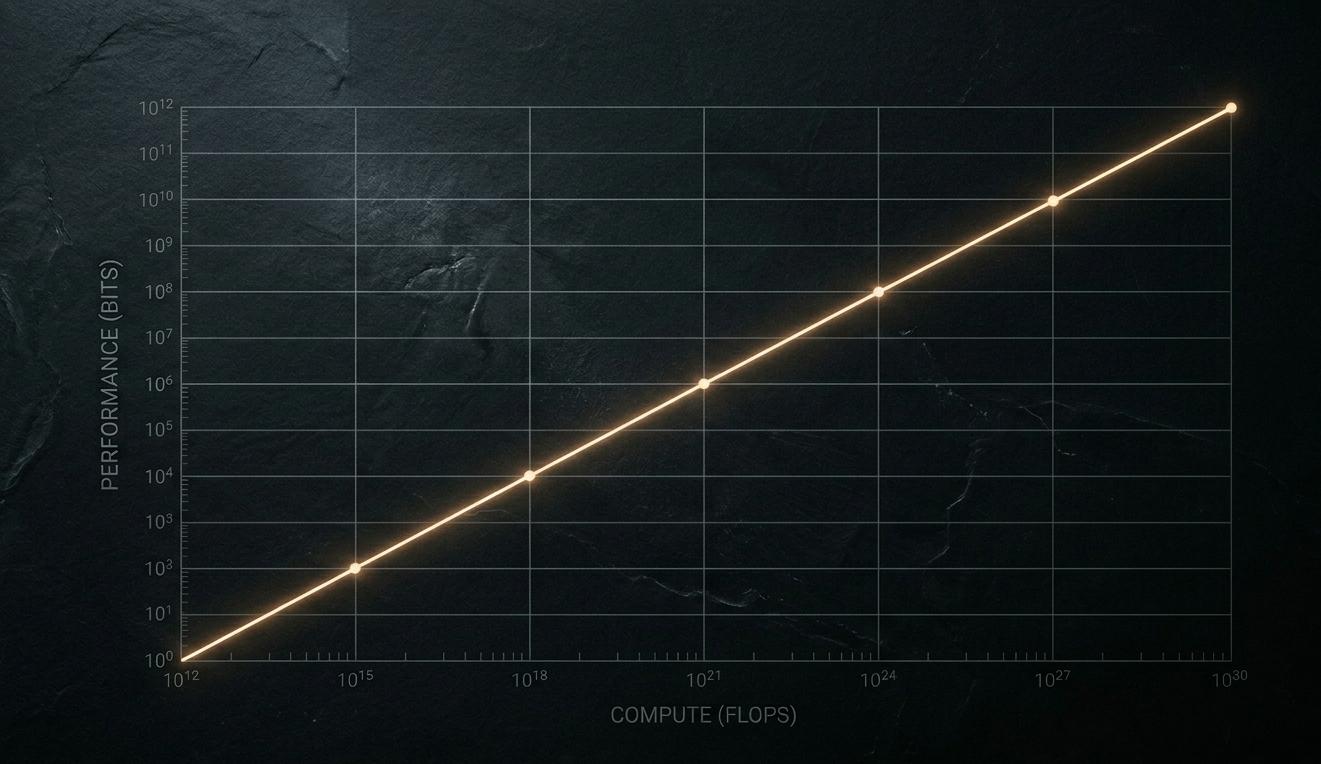
*Epistemic Status: Medium confidence.*
The Kaplan to Chinchilla to inference optimal synthesis relies on published empirical research. SWE Bench projections come from Epoch AI's capability forecasts. The governance window framing is my own synthesis and should be read as an exploratory argument, not a settled claim. Its accuracy partly depends on whether SWE Bench effectively represents a capability proxy for deployment. I approach this from the perspective of a systems architect who deals with compute and memory bandwidth constraints, applying those insights to forecasting questions. I welcome feedback, especially regarding the benchmark generalization assumption.
---
*The Core Claim*
Scaling laws are not just about how models improve. When used carefully, they can serve as a forecasting tool capable of predicting when governance-relevant capability thresholds are likely to emerge. My argument is that the empirical transition from Kaplan (2020) to Chinchilla (2022) and today's inference-optimal training regimes reveals a specific and limited governance window. This is the time during which institutions can prepare before a capability arrives, rather than scrambling to respond afterward.
This is not about when negative events might happen with AI. It is a specific idea: the math behind how we use computers can give us more warning than we realize, and we are not utilizing this warning enough.
---
*1. The Regime Shift: Kaplan to Chinchilla*
- Kaplan et al. (2020) showed that language model cross-entropy loss follows a stable power law across compute (C), parameters (N), and training data (D). Their key exponents, approximately α_N ≈ 0.076 and α_D ≈ 0.095, indicated that under a fixed compute budget (approximated as C ≈ 6ND), scaling model parameters faster than dataset size was optimal. This led to the "parameter-heavy, data-light" era of frontier AI, where GPT-3 had 175 billion parameters trained on only 300 billion tokens, a ratio of roughly 1.7 tokens per parameter.
- Hoffmann et al. (2022) in the Chinchilla paper challenged this. By fixing compute and systematically varying both N and D, DeepMind showed that optimal training required scaling both proportionally. Epoch AI's replication estimates the optimal ratio at about 25.6 tokens per parameter. In this regime, a 10x increase in compute suggests an increase of roughly 3.16x in both parameters and data.
---
*2. The Inference Optimal Deviation and What It Means for Monitoring*
Modern frontier labs have progressed beyond Chinchilla optimality to inference optimal training, which involves training smaller models on much more data to lower ongoing serving costs at deployment scale. The results are striking. While Chinchilla established a 20:1 data-to-parameter ratio, Meta's Llama 3 scaling laws operate at about a 1,875:1 ratio. Recent work from Tsinghua on small language models suggests ratios as high as 192:1. These models are undertrained compared to Chinchilla by 100x to 1000x, indicating significant remaining capability within existing parameter budgets.
This is not to say compute monitoring is useless. Rather, it is incomplete, and the inference optimal deviation has widened the gap between observable infrastructure signals and actual capability timelines.
---
*3. Forecasting the Threshold: SWE Bench as a Governance Proxy*
[Figure 1: SWE-Bench Capability Trajectory and Governance Window]
To make the governance window argument concrete, I need a specific capability proxy. I use performance on SWE Bench Verified, which measures an agent's ability to autonomously resolve real GitHub issues from open-source repositories. I recognize this is not a perfect proxy and I address the generalization objection in Section 5, but it is the most rigorously tracked benchmark for autonomous software engineering, which I see as the first economically significant autonomous capability milestone at deployment scale.
Epoch AI's published capability forecasts provide the following projections:
Non-specialized language model agents working under low elicitation conditions are expected to reach 54% on SWE Bench Verified by early 2026.
State-of-the-art agents with optimized scaffolding are projected to achieve 87% within the same timeframe.
The 90% threshold I identified as deployment-relevant autonomy has now been reached. As of May 2026, the leading model on SWE Bench Verified scores 93.9%, confirming the March 2026 median forecast. However, a newer and harder variant, SWE Bench Pro, shows scores of only around 23% for the best models, as it is designed to resist contamination and uses significantly more complex tasks. This suggests that while the original benchmark threshold has been crossed, true autonomous capability at deployment scale may still lie ahead — which strengthens rather than undermines the governance window argument.
There is also direct experimental evidence connecting training compute to economic productivity outcomes. A 10x increase in model training compute correlates with a 6.3% reduction in human task completion time. Approximately 56% of that gain comes from raw compute scaling, while the remaining 44% results from algorithmic improvements during the same period.
---
*4. Mapping the Governance Window*
Bringing these three observations together: the inference optimal regime shows that capabilities can advance without hardware warning signals; the 90% autonomous coding threshold on SWE Bench Verified has now been crossed, with the harder SWE Bench Pro variant indicating the full capability frontier extends toward the CI upper bound of late 2027; and the productivity evidence suggests this threshold has measurable economic impacts at scale.
Therefore, the governance window is not approaching — it is open right now. Institutions must build preparation into place before capabilities become widely deployed. This window has three key characteristics that current governance discussions often overlook:
- It is open now. The median forecast has been confirmed. The remaining window runs to the CI upper bound of September 2027.
- It is closing asymmetrically. The inference optimal deviation means that capability gains can arrive faster and with less external warning than hardware monitoring would indicate.
- It is partially knowable. Scaling law extrapolations provide probabilistic estimates rather than complete uncertainty. The appropriate governance response is to treat these estimates like any forecasting distribution: act on the central estimate while preparing for variability.
- The policy implication is not that governments should regulate based on SWE Bench figures. Instead, evaluation infrastructure, deployment monitoring frameworks, and institutional coordination mechanisms should be in place now, not hastily assembled afterward.
---
*5. Counterarguments*
- "Scaling laws may not continue." This is the most significant objection, and I believe it is valid as a long-term concern. Data constraints, particularly the limit of high-quality human generated text, are a real bottleneck. If synthetic data loops do not generalize, the inference optimal trajectory could collapse, extending timelines. My response is that the governance window argument is asymmetrical regarding this uncertainty. If scaling slows, the window extends, which is advantageous for institutional preparation. If scaling continues, the window is short and urgency is real. In either case, early preparation is not wasted. The argument does not require complete confidence in ongoing scaling; it only requires that the probability is not negligible, which I believe is clearly true.
- "SWE Bench doesn't generalize." That is true. A model capable of autonomously resolving 90% of GitHub issues might still struggle with long term planning, real-world interactions, or truly novel scientific reasoning. I am not claiming SWE Bench equals general capability. Rather, I argue it represents the first threshold where deployment has direct economic impacts at scale systems that can replace important parts of software development workflows and governance preparation should focus on this specific near-term threshold, not on an abstract notion of generally capable AI.
- "Institutions can respond after deployment." History shows this is not usually the case. There is often a delay of years between when new technology emerges and when decision-makers respond seriously. Social media is a prime example: researchers recognized its potential for influencing public opinion well before 2016, but significant action only took place after visible harm occurred, and some damage proved difficult to reverse. The real question is not whether institutions can respond post-deployment they can but whether they can act before things become entrenched and hard to change. With autonomous software agents, the risk is clear: they can restructure workforces and transform how essential systems operate faster than oversight can keep up. Leaders must be prepared before that happens, not afterward.
- "Current AI tools do not show productivity gains." The METR (2025) RCT found that experienced developers were 19% slower using early 2025 tools on familiar codebases. There are three responses. First, METR's own follow-up found that this effect had significantly decreased by early 2026. Their updated group showed only a -4% slowdown, and METR concluded that AI likely provides productivity benefits in early 2026. Second, the study measured human-AI collaboration on tasks developers had years of context on, which is precisely the situation where AI adds the least value. SWE Bench tracks the performance of autonomous agents, which is a different capability altogether. Third, the argument regarding the governance window is prospective. The speed of the METR reversal, from -19% to nearly zero in under a year, is itself evidence that the capability curve is steep enough to justify the preparation this post discusses.
---
*6. Conclusion*
Scaling laws should be viewed as governance instruments, not just engineering benchmarks. The mathematical shift from Kaplan to Chinchilla to inference optimal training reveals a capability frontier advancing in ways that specifically decouple from the hardware signals that current monitoring frameworks track. The SWE Bench trajectory has now confirmed its median forecast: the 90% threshold was crossed by May 2026. However, the emergence of SWE Bench Pro where the best models score only around 23% on contamination-resistant tasks indicates that the true autonomous capability frontier remains ahead, with the 95% CI closing by late 2027.
The governance window is open now, asymmetric, and crucially partially knowable. Policymakers should govern based on the empirical derivatives of compute allocation: not on science fiction pessimism, not on indefinitely optimistic timelines, but on the same kind of probabilistic forecasting that industrial planning and financial risk management already use routinely. The infrastructure for doing so needs to be built now, while the window is still open.